
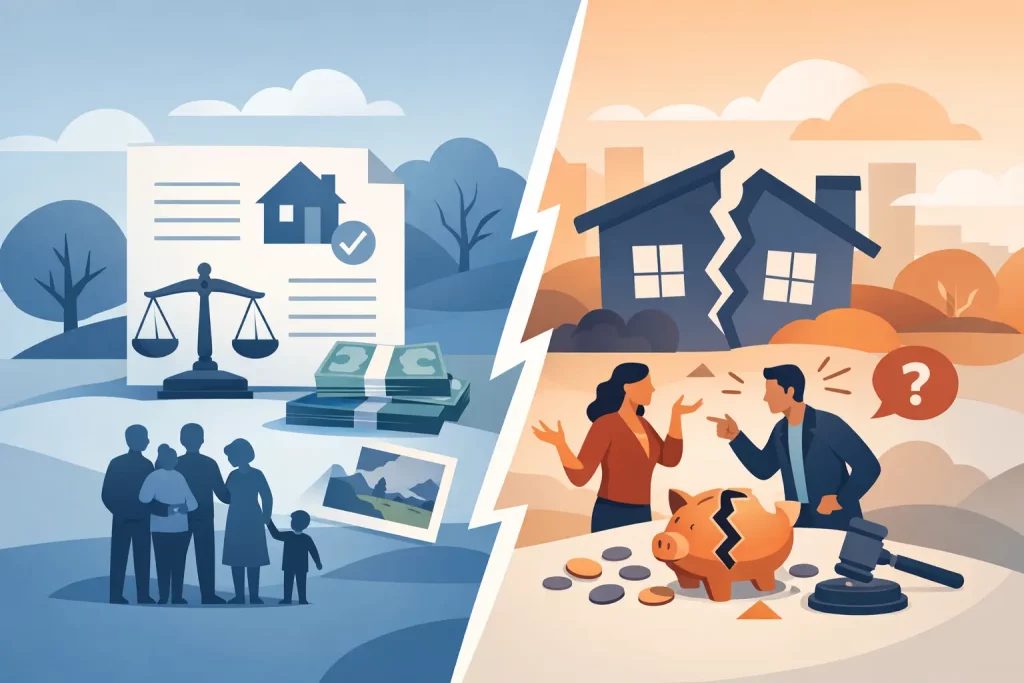
A surprising number of families only ask what happens without estate planning when something has already gone wrong. A death in the family, a sudden loss of capacity, or a disagreement over money can quickly turn an already difficult time into a stressful and expensive one. The problem is not usually a lack of care. It is simply that many people assume things will sort themselves out automatically.
In reality, if you do not put clear plans in place, the law steps in and makes decisions for you. Those decisions may be very different from what you would have wanted for your home, your savings, your children, or the people you trust most.
What happens without estate planning after death
When someone dies without proper estate planning, the first issue is often control. If there is no valid will, the estate is dealt with under the rules of intestacy. These rules set out who can inherit and who can apply to manage the estate. They do not take account of personal wishes, family dynamics, verbal promises, or what may seem fair in your particular circumstances.
For some families, that creates immediate problems. An unmarried partner may receive nothing, even after many years together. Stepchildren are not automatically included. Close friends, carers, and charities you may have wanted to benefit will usually be left out altogether.
Even where there is a surviving spouse or civil partner, the result may not be as straightforward as people expect. Depending on the value of the estate and the wider family situation, assets may not pass in the simple way many assume. That can leave families dealing with avoidable uncertainty at a time when they are already grieving.
The rules may not reflect your family life
Modern families are not always neat and simple on paper. Many households include second marriages, children from previous relationships, cohabiting partners, and informal care arrangements. Intestacy rules do not adapt well to that reality.
This is one of the clearest answers to the question what happens without estate planning. Your personal relationships may carry very little legal weight unless you have recorded your wishes properly. If you wanted to protect a partner, provide for a vulnerable child, ring-fence money for grandchildren, or make sure one beneficiary did not receive everything outright, those choices usually need formal planning.
Without that planning, the estate follows a legal formula. Sometimes that formula works reasonably well. Quite often, it does not.
Delays and added pressure on the family
A lack of planning can also slow everything down. If there is no will, there is no named executor ready to deal with the estate. Someone entitled under the rules has to apply to become the administrator. That can take time, and it can be complicated if family members disagree about who should take responsibility.
During that period, bank accounts may be frozen, bills still need paying, and practical matters keep piling up. Relatives are often left trying to sort paperwork, contact institutions, value assets, and understand legal processes with very little guidance. What should be manageable can become overwhelming.
Even where there is a will, poor or incomplete estate planning can still create hold-ups. Out-of-date documents, unclear wording, missing powers of attorney, or no plan for certain assets can all add friction when families need clarity most.
Family disputes become more likely
Most people do not set out expecting conflict, but uncertainty is one of the quickest ways to create it. If your wishes are not written down clearly, relatives may interpret your intentions differently. One person may believe they were promised the house, another may feel they should be repaid for years of care, and someone else may assume everything should be divided equally.
These disagreements are not always about greed. Often they come from grief, misunderstanding, or genuine differences in what people think you wanted. Even so, the emotional and financial cost can be significant.
Clear estate planning reduces that risk. It does not guarantee that no one will ever be unhappy, but it gives your family a much stronger framework to follow. That alone can preserve relationships at a time when they are under strain.
Children may be left without clear arrangements
For parents, one of the most serious issues is guardianship. If you have young children and you die without a valid will, you lose the chance to state clearly who you would want to care for them. The court may need to become involved if there is uncertainty or disagreement.
That does not mean the wrong person will automatically take over, but it does mean a deeply personal decision may be taken out of your hands. At the same time, there may be no proper structure for managing money on a child’s behalf. Assets left to children can become more complicated to administer, especially where no trust arrangements have been considered.
For many parents, this is the point at which estate planning stops feeling optional. It becomes part of protecting the people who depend on you.
What happens without estate planning if you lose mental capacity
Estate planning is not only about what happens after death. It is also about what happens during your lifetime if illness, injury, or conditions such as dementia affect your ability to make decisions.
Without a Lasting Power of Attorney in place, your family cannot simply step in and deal with your finances, property, or welfare decisions because they are your spouse or child. Many people are surprised by this. In law, authority has to be granted formally.
If you lose capacity without the right documents in place, loved ones may have to apply to the Court of Protection to be appointed to act for you. That process can be slower, more expensive, and more restrictive than putting a power of attorney in place in advance. It can also create practical problems while the application is ongoing, especially if bills need paying or care decisions need to be made.
This is a part of estate planning that people often postpone because it feels uncomfortable. In practice, it is one of the most useful protections you can arrange.
Your estate could face unnecessary cost
No estate planning does not always mean higher tax, but it can mean missed opportunities. A properly considered plan may help make better use of available allowances, structure gifts sensibly, or protect certain assets for future generations. Without that thought in advance, families may end up paying more than necessary or losing options that would once have been available.
There can also be extra administrative cost. Delays, court applications, disputes, and unclear paperwork all have a financial effect. Even smaller estates can become more expensive to deal with if no one has been given clear authority or instructions.
It is worth being realistic here. Estate planning is not a magic answer to every tax or probate concern. Some estates are simple, and some family situations are complex whatever you do. But having the right documents in place usually makes matters far easier and more efficient than leaving everything to chance.
Business owners and homeowners face particular risks
If you own a home, have savings, or run a business, the consequences of poor planning can be more serious. Property may need to be sold unexpectedly. Business interests may be left in limbo. Joint ownership arrangements may not work in the way the family expects. Debts and liabilities still have to be dealt with, regardless of how unprepared the estate may be.
For homeowners in particular, assumptions are common. People often think the house will automatically pass as they intend, but that depends on how it is owned and what legal documents are in place. For business owners, the absence of planning can disrupt not only the family but also staff, customers, and co-owners.
This is where tailored advice matters. Good estate planning is not about using the same document for everyone. It is about matching the arrangements to your circumstances.
Why people delay it
Most delay comes from understandable reasons. People are busy, the subject feels uncomfortable, or they assume they do not have enough assets for it to matter. Some think they are too young. Others believe their family will know what to do.
Unfortunately, good intentions do not create legal authority. Verbal wishes are often difficult to prove, and assumptions can be wrong. Estate planning is not just for the wealthy. It is for anyone who wants the right people making the right decisions at the right time.
That is why straightforward guidance makes such a difference. A calm conversation can often turn a subject people have avoided for years into a manageable set of practical steps.
A better outcome starts with simple planning
When people ask what happens without estate planning, the honest answer is that life becomes harder for the people you care about. The law follows its own process, not your personal wishes. Families may face delays, uncertainty, added cost, and decisions that feel impersonal or unfair.
The good news is that this is usually preventable. A valid will, appropriate powers of attorney, and the right supporting arrangements can give your family clarity and peace of mind. For many people, the hardest part is simply getting started.
At Your Will Writers, that first step is often much simpler than people expect. A sensible plan put in place now can spare your family a great deal of stress later, and that is one of the kindest things you can do for them.