
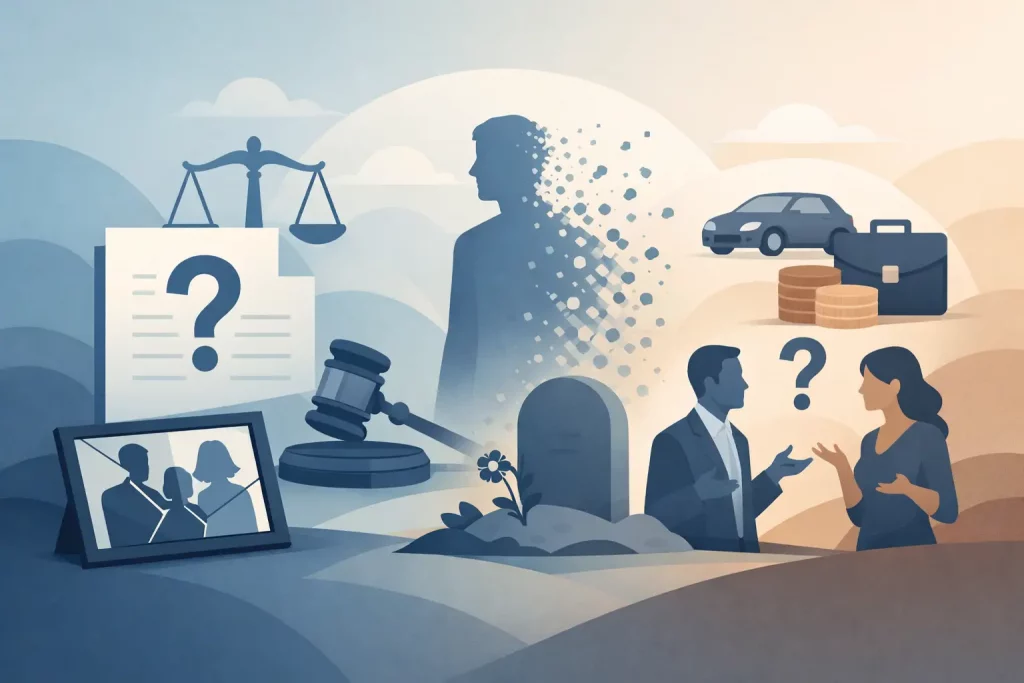
A lot of families only discover the answer to what happens if you die without a will when they are already dealing with a death. At that point, simple questions can become stressful very quickly. Who is in charge? Who inherits? What happens to the home? And what if the person who died had a partner but was never married?
When someone dies without a valid will in England or Wales, they are said to have died intestate. That means the law decides who can deal with their estate and who receives it. For some families, the outcome may roughly match what the person would have wanted. For many others, it does not.
What happens if you die without a will in England and Wales?
If you die without a will, your money, property and possessions do not automatically go to the people closest to you in the way many assume. Instead, strict intestacy rules apply. These rules set out an order of priority for inheritance.
The estate usually passes first to a surviving husband, wife or civil partner, then to children, and then to other relatives in a fixed order if there is no spouse or child. Unmarried partners, however long they have been together, do not inherit under these rules. Stepchildren also do not inherit unless they have been legally adopted.
This is often the point where families realise how important proper planning is. Personal wishes, verbal promises and informal understandings do not override the legal position.
Who inherits under intestacy rules?
The exact outcome depends on who survives the person who has died and the value of the estate. There is no one-size-fits-all answer, which is why professional guidance can be so helpful.
If there is a spouse or civil partner and no children
In this situation, the spouse or civil partner usually inherits the whole estate. That may seem straightforward, although practical issues can still arise if assets were held in complex ways or if there are questions over ownership.
If there is a spouse or civil partner and children
Here, the rules become more detailed. The spouse or civil partner receives all personal possessions, a fixed sum from the estate, and part of anything above that amount. The children inherit the remaining share.
That can create unexpected complications, especially where the main asset is the family home. A surviving spouse may find that children are also entitled to a share of the estate even if everyone assumed the home would simply pass to the surviving parent.
If there is no spouse or civil partner
The estate passes down the family line in a set order. Children usually inherit first. If there are no children, it may pass to parents, then brothers and sisters, then more distant relatives such as half-siblings, grandparents, aunts and uncles.
If no eligible relatives can be found, the estate may pass to the Crown. That is rare, but it does happen.
What if you live with your partner but are not married?
This is one of the most misunderstood areas of estate planning. Many people believe that a long-term partner automatically has rights as a “common law spouse”. In England and Wales, that is not how intestacy works.
If you die without a will, an unmarried partner has no automatic right to inherit, even if you have lived together for years, shared bills or raised children together. They may need to bring a claim against the estate, which can be costly, time-consuming and emotionally draining.
This can be particularly serious if the home was owned solely by the person who died. The surviving partner may be left in a very uncertain position at exactly the moment they are least equipped to deal with it.
Who deals with the estate if there is no will?
A will normally names executors. Without one, there are no executors, so someone must apply to be appointed as the estate administrator.
There is an order of priority for who can do this, usually starting with the surviving spouse or civil partner, then children, and then other relatives. The administrator takes on much the same practical role as an executor. They gather assets, settle debts, deal with financial institutions, complete the necessary paperwork and distribute the estate according to the intestacy rules.
That may sound simple on paper, but it can be demanding in practice. If family members disagree about who should take the role, or if the estate includes property, business interests or missing paperwork, delays are common.
What happens to children if you die without a will?
A will does more than pass on money. It can also name guardians for minor children. If there is no will, you lose the chance to make that choice formally.
If one parent dies and the other parent with parental responsibility is alive, the surviving parent will usually continue caring for the children. But if both parents die, or the surviving parent cannot care for them, the court may have to decide who should step in.
That can be deeply upsetting for families. Relatives may disagree, and the people chosen by the court may not be the people you would have selected yourself. A will gives you the chance to make your wishes clear.
What about debts, bank accounts and jointly owned property?
Dying without a will does not make debts disappear. Debts and liabilities are usually paid from the estate before anything is passed on to beneficiaries. If the estate is modest, there may be little left once funeral costs, outstanding bills and other liabilities are settled.
Joint assets need careful attention too. Some jointly owned property passes automatically to the surviving owner, depending on how it was owned. Other assets may still form part of the estate and be dealt with under intestacy rules. Bank accounts, savings, property and life policies can all fall into slightly different categories.
This is why assumptions can be risky. Families often think everything will automatically transfer to the surviving partner, only to find that the legal position is more complicated.
Why intestacy can cause family problems
The law provides a framework, but it does not know your family. It does not account for second marriages, estranged relatives, stepchildren, vulnerable beneficiaries or promises made over many years.
That is where problems often begin. A person may have wanted to provide for an unmarried partner, leave something specific to a grandchild, or protect money for children from an earlier relationship. Without a will, those intentions may not be reflected at all.
Even in close families, uncertainty can create tension. If one relative is applying to administer the estate, another is waiting for money, and a third believes the deceased wanted something different, disagreements can build quickly.
Can someone challenge the outcome?
Sometimes, yes. Although intestacy rules are fixed, certain people may be able to make a claim if they believe they have not been reasonably provided for from the estate. That can include spouses, former spouses in some cases, children, and someone who was being financially maintained by the person who died.
These claims are highly fact-specific. They are not guaranteed, and they can lead to delay, legal costs and stress for everyone involved. In other words, relying on a later challenge is a poor substitute for putting a proper will in place.
Why making a will usually saves trouble later
A will gives you control. It allows you to decide who inherits, who administers your estate, who should look after children, and how specific assets should be handled. It can also work alongside wider planning, such as trusts or lasting powers of attorney, depending on your circumstances.
For some people, a simple will may be enough. For others, especially those with children from previous relationships, an unmarried partner, a business, or a property they want to protect, more tailored planning makes sense. The right approach depends on the family, the assets and the outcome you want.
That is why plain-English advice matters. Most people are not looking for legal jargon. They simply want the reassurance that their family will be looked after and that difficult decisions will be easier when the time comes.
At Your Will Writers, this is exactly why estate planning is approached in a straightforward, personal way. The aim is not to make the process feel heavy or intimidating. It is to help people put clear arrangements in place so their wishes are respected.
Leaving things to the intestacy rules may work out acceptably in a few cases, but it is rarely the best plan. If the people you care about matter to you now, putting your wishes in writing is one of the kindest things you can do for them later.