
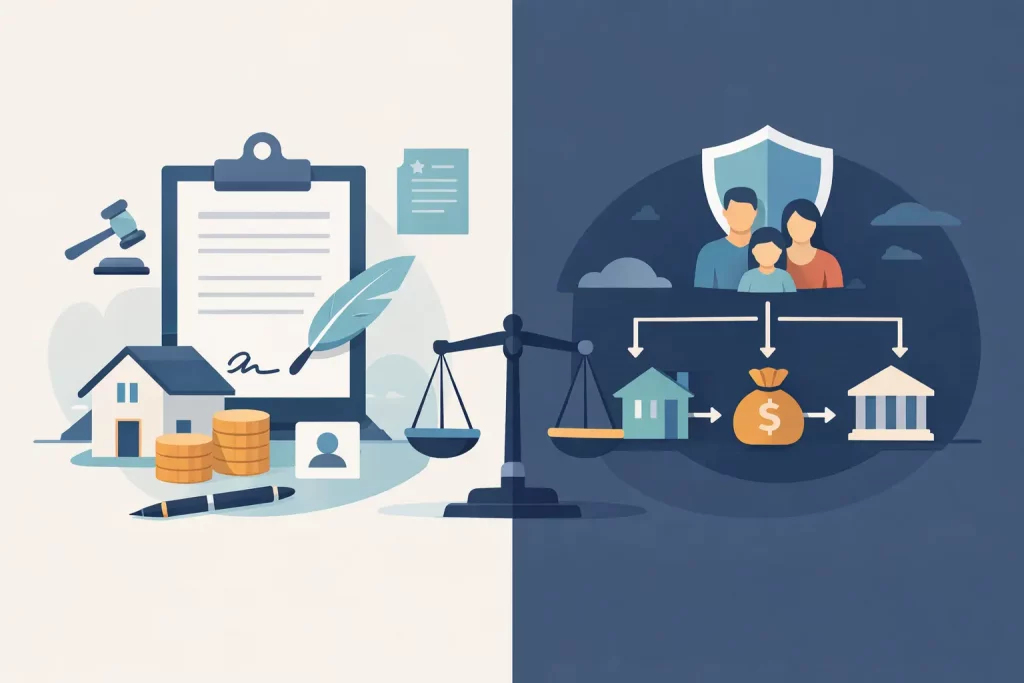
Many people ask about the difference between will and trust when they start thinking seriously about protecting their family. It usually comes up after a life change – buying a home, having children, remarrying, or helping ageing parents. The confusion is understandable because wills and trusts can work together, but they do very different jobs.
A will is a legal document that sets out what should happen to your estate after your death. A trust is a legal arrangement that allows assets to be held and managed by one person or group of people for the benefit of someone else. That is the simplest distinction, but in practice the choice is often less about one or the other and more about what outcome you want.
The difference between will and trust at a glance
A will takes effect on death. It names executors, says who should inherit, and can appoint guardians for children. If you do not have a valid will, the rules of intestacy decide who inherits, and that may not reflect your wishes.
A trust can take effect during your lifetime, on death, or both, depending on how it is set up. It places assets under the control of trustees, who must manage them according to the terms of the trust for the chosen beneficiaries. That can be useful where you want more structure, more protection, or more control over how and when assets are used.
So if you are comparing the difference between will and trust, one key point is timing. A will speaks after death. A trust can operate before death, after death, or across both periods.
What a will is designed to do
For most people, a will is the starting point. It gives clear instructions about who should inherit your money, property and personal belongings. It also allows you to appoint executors to deal with your estate and, if you have children under 18, guardians to care for them.
A properly drafted will can also help reduce the risk of family disputes. It brings clarity at a difficult time and gives your loved ones a clear legal record of your wishes. In many estates, that alone provides significant peace of mind.
A will can include trust provisions as well. This is where the topic becomes more nuanced. Some people think a will and a trust are alternatives, but a will can actually create a trust on death. For example, you may want assets held for children until they reach a certain age, or you may want to protect a share of your estate for a surviving spouse while preserving it for children later.
Still, a will has limits. It does not control what happens to jointly owned assets in every case, pension death benefits, or assets already placed in trust. It also does not usually avoid probate where probate is required.
What a trust is designed to do
A trust is often used where a straightforward gift is not the best option. Rather than passing an asset directly to a beneficiary, the asset is held by trustees, who look after it under the rules you set.
That can help in a range of situations. You may have young children who are too young to inherit outright. You may want to provide for a vulnerable beneficiary. You may wish to protect part of an estate in a second marriage situation. You may want to ring-fence assets such as property or savings so they are managed carefully rather than received in one lump sum.
Trusts can also be useful for tax planning and asset protection in some circumstances, but this is where people need careful advice. A trust is not a magic solution. Different trusts have different tax treatment, different reporting duties and different levels of flexibility. What works well for one family may be unnecessary or unsuitable for another.
Control is one of the biggest differences
If you leave someone money in a will outright, they become fully entitled to it once the estate has been administered. That is simple and often entirely appropriate.
With a trust, the trustees keep legal control of the asset and manage it for the beneficiary. The beneficiary may still benefit from the asset, but not necessarily on their own terms or timetable. This can be helpful if the beneficiary is a child, lacks capacity, struggles with money, or if you simply want stronger safeguards in place.
That extra control is often the real answer when clients ask about the difference between will and trust. A will is usually about distribution. A trust is often about management and protection.
Cost and complexity matter too
A will is generally simpler and more affordable to put in place than a trust. For many families, that makes it the right first step. If your wishes are relatively straightforward and you mainly want to ensure the right people inherit, a well-drafted will may be enough.
A trust is usually more complex. There may be ongoing trustee responsibilities, record-keeping requirements and tax implications. Trustees must understand their role and act properly. That is why trusts should never be set up simply because they sound like a more advanced option.
Sometimes people hear that trusts avoid problems automatically. In reality, they can solve certain problems while creating extra administration if they are not genuinely needed. Good estate planning is about choosing the right tool, not the most complicated one.
When a will may be enough
A will may suit you well if your estate is fairly straightforward, you want to name guardians for children, and you are happy for beneficiaries to inherit directly. It can also be appropriate where your main priority is making your wishes clear and avoiding intestacy.
For many couples and individuals, that is the sensible place to begin. A clear, professionally prepared will can deal with family provision, specific gifts, funeral wishes and the appointment of trusted executors. It is often the foundation of a wider plan.
When a trust may be worth considering
A trust may be worth discussing if you want to protect assets for children, support a vulnerable person, manage inheritance in a blended family, or control when money is released. It may also be useful if you are concerned about preserving assets across generations rather than passing everything outright at once.
Property protection planning is one area where trusts often arise, particularly for married couples or civil partners who want to ensure part of the family home is ultimately preserved for children. Again, whether that is appropriate depends on personal and family circumstances, ownership structure and the wider estate plan.
This is where tailored advice matters. Estate planning works best when it reflects real family dynamics rather than generic assumptions.
Will and trust can work together
One of the most common misunderstandings is thinking you must choose between them. In many cases, the best answer is both.
A will can appoint executors, name guardians and set out your wishes generally, while also including a trust that only comes into effect after death. That approach can combine clarity with protection. You keep the simplicity of a will, but add a trust where there is a clear reason for one.
This is often useful for parents of younger children, people in second relationships, or families where a beneficiary may need support rather than a direct inheritance. It is also a practical reminder that estate planning is not one-size-fits-all.
Common mistakes people make
The first mistake is assuming a will covers every asset automatically. Some assets pass outside the will, depending on how they are owned or nominated.
The second is assuming a trust is always better because it sounds more protective. Protection only helps if the trust is properly chosen, correctly drafted and sensibly administered.
The third is putting off the decision altogether. Doing nothing can leave families with uncertainty, delay and outcomes you never intended. Even a simple plan is usually far better than no plan.
How to decide what is right for you
Start with the practical questions. Who do you want to benefit? Are any beneficiaries young, vulnerable, or likely to need help managing money? Do you want assets passed outright, or held back under clear conditions? Are there concerns around remarriage, family conflict, or preserving part of an estate for children?
You should also think about who would act as executor or trustee. A trust is only as good as the people managing it. Choosing reliable, sensible individuals is just as important as choosing the legal structure itself.
For many people, the right route becomes clearer once the options are explained in plain English. That is often where a specialist estate planning service makes the biggest difference. Firms such as Your Will Writers focus on making these decisions feel manageable rather than intimidating.
The best estate plan is not the one with the most paperwork. It is the one that fits your family, protects the right people and gives you confidence that things will be handled the way you intended. If you are weighing up a will, a trust, or a combination of both, the most helpful next step is usually a proper conversation about your circumstances rather than a guess based on general information.